
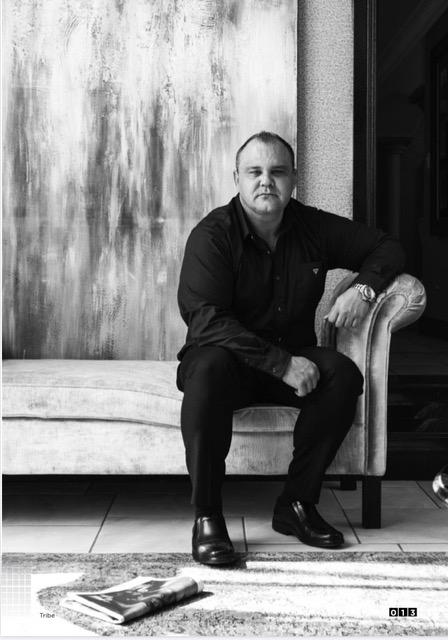
Arnoux Mare
How innovative solutions group changed the system
When Arnoux Mare decided to turn the labour brokering sector on its head by contractually employing staff on a permanent basis, everyone said it made no sense.
In the South African business environment, new startups and small to medium companies often struggle to compete with the large, dominant enterprises. Once established, they may find it difficult to access further capital and the resources needed for them to grow. Then there are the business functions that require the owner’s or CEO’s full attention: accounting, auditing, staffing etc. Wouldn’t you want to concentrate on what really matters—growing your business? Enter Innovative Solutions Group (ISG). Founded by visionary entrepreneur Arnoux Maré, who understands the challenges of owning a business, ISG outsources such functions to facilitate the smooth running of a fledgeling company—with trustworthy service providers who act as a proxy, assuming the same level of responsibility and accountability as the company itself would. “A lot of people don’t understand how difficult business has become.
In the old days, the owner of the company was the CEO, the marketing manager, the financial manager, the HR manager—but you can’t do that in today’s environment,” he told Tribe Business Magazine. This is not a labour broking service. As Maré explained, “The difference between what we are doing and labour broking is quite easy to understand. Labour brokers’ staff is always temporary workers, often called a ‘limited duration contract’, even where employment contracts or policies refer to them as ‘permanent’. These temporary employees are deprived of their basic rights as workers in the sense that they can’t even apply for credit or a cellphone contract. So we changed the system.”
A new approach
A recent study by financial advisory firm Deloitte identifies outsourcing as a key enabler of economic growth and job creation. The outsourcing industry has elevated the economies of other emerging markets such as India and the Philippines. “As an outsourcing company,” said Maré, “we employ more than 16 000 permanent staff over a variety of sectors including transport, mining, logistics, engineering, hospitality and agriculture. We don’t employ any temporary staff, therefore ensuring workplace stability and continued security for workers and their families.” By employing workers full-time, a company actually builds a relationship with these staff members—empowering them to
work optimally and in positions that suit them best. ISG receives around 8 000 CVs a week and employs approximately 2 000 people a year. In 2017, the company employed a person for every working hour. Currently, ISG manages 30 companies in sectors such as mining, engineering, logistics, financial services, construction and agriculture, and is looking toward the entertainment sector in the near future.
“Our focus is people excellence, so our operations are people.”
It has operations countrywide with offices in cities such as Cape Town, Durban, Port Elizabeth, Kuruman, Polokwane, Tzaneen, among others. Outside South Africa, it operates in the United States, New Zealand and Mozambique, and will soon be moving into Europe. ISG’s Innovative Staffing Solutions subsidiary takes responsibility for the entire human resources function, which allows its clients to focus on their growth strategies and core competencies.
“It’s important to note that legitimate outsourcing companies are not labour brokers or temporary employment services, but organisations where both the employees and the companies are protected,” Maré stressed. “At Innovative Staffing Solutions, we contractually employ our clients’ staff on a permanent basis. This means we take over a client’s drivers, hospitality workers or farmworkers by reinstating them as permanent employees, but they continue to work for said client. In exchange, employees receive benefits they may not have received previously, while the client’s HR needs are handled, such as finding suitable staff and dealing with disciplinary issues.”
ISG’s other subsidiaries are: Innovative Accounting Solutions, which outsources financial and accounting processes; Innovative BEE Solutions, which assists companies to comply with Broad-Based Black Economic Empowerment regulations and improve their Scorecard ratings; and Innovative PPE Solutions, which ensures personal protective equipment and clothing meet legal requirements and are of the highest quality.
Spirit of an innovator In 2017 and 2018, Maré and ISG walked away with the laurels at the annual Africa Leadership Awards held in Mauritius. One of the awards lauded ISG as the “Dream Company to Work for in Africa”. The self-made millionaire grew his turnover from R32 million in 2013 to an astonishing R2 billion in 2019. Maré is proud to have created a new service that had never been heard of before. “Everyone knew what labour broking was, everyone knew what recruitment firms were, but what I was pitching to the market was something unheard of.
I was telling companies to trust me with their most valuable asset, which is their people—which can also be their biggest liability, depending on how they’re managed. But nobody actually wanted to listen to me! Everybody told me I was doing it wrong, everybody said it was not the way to go, everybody said it was impossible because to them it didn’t make sense to employ people full-time.“There were a lot of challenges, but I kind of like challenges. I like it when people say you can’t do it and I try to prove them wrong. I’m a firm believer that second place is really a politically correct term for the first loser. I don’t like being told that it’s impossible. People telling me it was impossible actually got me to push even harder,” he added.
Managing people “a Science”
Innovative Staffing Solutions takes the headache of managing staff away from company owners because it’s a science to manage people, said Maré. “We’ve stopped managing work and started managing people. We manage the human resources while we let the company manage its core business, for example, engineering. There are so many facets when it comes to running a business: there’s safety, payroll, human resources, sales, marketing, operations, but the people who do the operations are not the focus of the company—the operational excellence is their focus.
“Our focus is people excellence, so our operations are people.” He continued, “It’s very important to understand the psyche of humans when working with them. If you have a disgruntled, unhappy employee, the production will be cut by at least 60%. However, if you have a happy employee who is proud of where he or she works, the production goes up, morale goes up, everything works better. We can provide a better service for our clients at the end of the day, running the operations for them by managing the people correctly, while they manage production, marketing and all those things they need to take the business forward. We manage the people to ensure the actual business is done.”
Maré iterated that ISG’s employees are managed on a human level, not just on a work level. “I’m a firm believer that you need to strike a delicate balance between the two, because if you manage your employee correctly and at the same time empower him to do his job to the best of his ability, it will be beneficial to both the worker and the company.” Central to the company’s operations is the well-being of its most important asset: its human resources. ISG values its workforce so much that it has created systems and benefits for its employees that are second-to-none in the market.
“We’ve taken hands with a major medical aid company to assist all our employees, including more than 6 500 truck drivers, to enjoy better medical benefits at a fraction of the cost. This also allows lower- earning employees medical aid assistance.” Asked whether ISG trains people internally, Maré said it depends on the type of training. Specialised training is outsourced, while the company does the rest in-house, such as with soft skills. “We also adapt our training to our clients’ needs. We need to build a person into a job, not a job into a person— and that’s the mistake many companies make.” He added, however, that even though he’s a firm believer in education, people have to learn to think outside the box.
Many people concentrate so much on studying that they start thinking inside the parameters of their studies, never looking for answers outside—and no business can be run like that. “There’s no single degree, not even an MBA, that teaches you how to run a business. I concentrate on what I do best and outsource that which I can’t do best. A leader must be able to realise he can’t do everything and work with a team who’s able to achieve the best results.”
ISG in action
ISG’s very first contract showcased the efficacy of the business model, and the client ended up marketing ISG to its own sister companies and business associates. Maré hasn’t looked back since. Due to client confidentiality, he isn’t able to name any of ISG’s clients, but one success story deserves to be shared: “Pienaardam in Middelburg is made up of resorts, agricultural facilities and a few other elements. A few years ago, we took over their staff, which was very unionised and militant. We started handling the negotiations with the unions and, of course, because we speak the same language as the unions, we could assist the process— remember, we also understand the challenges the unions face. We took over about 200 employees, and to this day we still handle the account. We always look at it as creating a win-win situation for our client because if they’re operationally sound, so are we.”
A sector that has proved difficult is transport. “It’s a very militant, very difficult market, riddled by a lot of industrial action,” Maré revealed. “But our clients don’t have to face these challenges. With our carefully executed systems, I’ve managed to bring down industrial action among our transport clients by 92% and operational costs by up
to 60%, just by managing people correctly. “If your employees are unhappy, they start using a lot of sick leave they’re not supposed to; they start taking days off and they don’t put enough effort into their work. By managing them correctly, showing them that they’re important and that they are part of the programme, we’ve changed things around. We’ve had a company that started with 80 trucks. Two years after being our client, they now own 230 trucks. So we’ve grown the company exponentially just by managing people correctly.” ISG is the biggest supplier of code 14 drivers in the country, with more than 6 500 drivers fully employed by the company on a permanent basis. Maré added that working with people can be very difficult, especially in South Africa where there are 11 official languages and many cultural differences. ISG has implemented ways to handle issues that arise.
No rivals
Asked how he handles the competition, Maré chuckled and said, “We don’t have competition. We honestly don’t see other companies as competition. We look at ourselves and it’s all we do. We do market research to determine market trends and where industries are going, and that’s all. If you want to be a sheep, look at the competition and do what they do. If you want to be a wolf, lead the competition to what they want to do.” Every four months the company is dissected and systems are looked
at to see how they can be improved. “We only improve ourselves and don’t care what the other companies are doing, because they cannot compete with us—it’s impossible.”
Looking to the future On the subject of the 4th Industrial Revolution, Maré was quick to
stress that people needn’t be afraid of change. Rather, companies should “adapt and thrive”. According to him, South Africa has one of the most stifled business environments in the world, with panels that control everything—a detriment in many instances. “There are so many restrictions in certain sectors that the sector can’t change. So how do you prepare for change if it’s impossible to change? If you can’t adapt your company for changes coming in the market, how do you prepare for that change?
We should allow companies a bit of freedom to express themselves.” Maré said he already foresaw the change in legislation on labour brokers when he started his product in 2010. He spoke to labour brokers, and was willing to give his entire product to them but they refused, saying it wasn’t economical to employ people on a permanent basis. He wasn’t deterred, and continued working on his product and eventually launching it successfully in the market.
“You need to foresee problems and you need to calculate your risk, because business is nothing more than risk management.” As an example, in August last year the Constitutional Court found that a labour broker cannot hold an employment agreement for more than three months. Within an hour of that being announced, 17 labour brokers called Maré, asking him to buy their companies. He declined the offer and started pitching their clients instead.
Teach them to fish—and beyond
It’s important for successful businesspeople to give back to society, which is why Maré has established the non-profit Arnoux Maré Foundation. “We’re involved
in a lot of charity work, especially children’s homes. However, the project I’m very passionate about is one with entrepreneurship as its core objective. We’ll invite entrepreneurs to engage with me, free of charge, to receive input and advice on how they can improve their businesses, regardless of the size or success of their business.”
Maré believes that give a man a fish and you feed him for a day; teach a man to fish and you feed him for a lifetime.
But he wants to take this even further—he also wants to teach people how to build
the rod, line the reel, cast it in, wait for the bite and then reel the fish in.“It’s easy to talk about teaching a man how to fish, but there are lots of aspects that build up to that: what bait you use, and so on. People see the end product, but they don’t know how to get there.” The Arnoux Maré Foundation is being marketed quite aggressively, and Maré is excited about the possibility of changing people’s lives. We’re sure he’ll do just that—and do it well.