
Down to Business
Designed by Nature
How Patrick Mavros is bringing the beauty of Africa to the world through extraordinary jewellery and sculptures inspired by Zimbabwe’s wildlife
Every item made by the Mavros family in their House of Jewels is infused with love—love of their art, and love of Africa.
With such a focus on heritage, it’s no surprise that Patrick Mavros puts the spotlight on wildlife conservation for generations to come.
It all began with one pair of earrings. Intended as a loving gift for his then-fiancée Catja, Patrick Mavros handcrafted the rose-shaped jewellery in 1978 while recuperating from illness—he was still a baker at that time. When she wore them to the local salon, her hairdresser immediately noticed them and requested her own pair. Soon the other ladies in the salon also expressed their desire for these delicately beautiful handworks.
Now, decades later, Patrick Mavros is a successful family-run company, with all four of the Mavros sons also lending their creativity and expertise to the business.
Their unique luxury products represent a “safari of adventure, romance and above all unquestionable quality”. Their rationale behind starting the business was to develop a luxury brand on the continent. America has Tiffany & Co., and France has Hermès—so why not Patrick Mavros for Africa?
In addition to men’s and women’s jewellery in 18-carat gold and sterling silver, their range includes homeware such as teaspoons, cocktail swizzle sticks, napkin rings, as well as beautiful sculptures, candelabras, paperweights, placecard holders and pen pots. Every single piece has been designed by a member of the Mavros family.
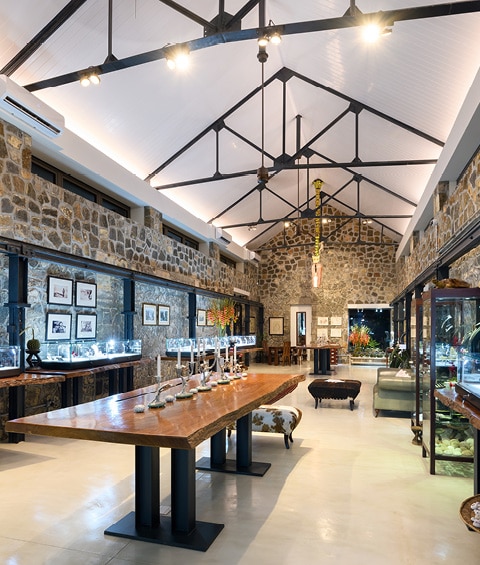
The Patrick Mavros headquarters in the hilly outskirts of Harare, Zimbabwe is operated out of a studio and wildlife sanctuary. It’s here in the Umwimsi Valley where Patrick and Catja brought up their four sons—Alexander, Forbes, Benjamin and Patrick Jr—in an environment that honed their creativity and ignited their passion for the business. Pieces are also made and sold in their Mauritius atelier (headed by Forbes), with other stores in Harare, Nairobi and London.
As with that very first pair of earrings, every item made by the Mavros family in their House of Jewels is infused with love—love of their art, and love of Africa. This care and attention is evident in every facet of the business: from design and production to customer service.
It’s all about bringing the beauty of Africa to the world through extraordinary jewellery and sculptures inspired by Zimbabwe’s wildlife. The Mavros family feels most African products tend to be mere curios, which can become gimmicky; so they attempt instead to update native art or traditions for the modern, luxury market. For instance, Forbes’ Elephant Hair Bangle is based on the centuries-old African bracelet that was crafted by elders when a young hunter or warrior killed his first elephant. It was believed that wearing the bracelet would imbue the warrior with the might of the elephant on his journeys across the continent.
All their pieces are timeless heirlooms that can be handed down from generation to generation. Indeed, family heritage is a hallmark of the Patrick Mavros brand. They’re immensely proud to be the oldest European family in Zimbabwe, and to be part of the Great African Story.
With such a focus on heritage, it’s no surprise that Patrick Mavros puts the spotlight on wildlife conservation for generations to come. Not only are there collections embodying the beauty of African animals such as the crocodile, hippo and elephant—but also collections that mirror the wonders of the seas and oceans. The Ocean Tides collection is inspired by the tides in Mauritius which, once or twice a year, go so low that the coral reefs are exposed, revealing the true colours of the undersea world; Patrick Mavros has sourced gemstones reflecting these soft hues. Kate, the Duchess of Cambridge, was seen sporting earrings from this gorgeous collection during the COVID-19 lockdown in the United Kingdom.
And Patrick Jr’s Pangolin Collection, in collaboration with photographer Adrian Stern, is raising incredible awareness on a global scale for the plight of the world’s most trafficked mammal, the shy pangolin anteater. Ten percent of sales from this jewellery collection is donated to the Tikki Hywood Foundation’s Trust in Zimbabwe to help continue its conservation efforts. (See this edition’s The Object feature for a look at one of the pieces in this remarkably well-crafted collection.)

Wax on, wax off
How Patrick Mavros silver sculptures are made
Every silver sculpture is made using the ancient technique of lost wax casting, refined over many years in the Patrick Mavros workshop to yield exceptional results. A handmade wax model is encased in liquid rubber which, once set, is carefully cut away to provide a ‘negative’. Into this cavity, molten wax is injected, allowed to cool and then removed from the rubber mould in the form of the original.
After thorough checking, the new wax model is covered with investment powder and fired. The heat melts the wax, which trickles out through a tiny aperture. All that remains in the plaster is a perfect hollow in which every surface detail of the wax model is captured. Molten silver is then poured into the plaster mould.
Once the silver has cooled, the plaster mould is broken open to reveal the silver casting. The casting is then cleaned and checked to see that every detail of the original has been faithfully reproduced in silver. Finally, the piece is hallmarked and polished.
Related Articles
Related

South Africa’s connectivity future depends on people, not just percentages.
Here’s the truth about how connectivity is seen broadly. Walk into any boardroom and you will hear comforting numbers. 99.9% uptime and megabits per second north of 100. C-suites might talk about ironclad SLAs.

The water is changing. Reimagining Governance for an Infinite Game
There are two young fish swimming along when they meet an older fish swimming the other way. The older fish nods and asks, “Good morning. How’s the water?” The young fish swim on for a while until one turns to the other and asks, “What the hell is water?”

South Africa Becomes Global BPO Contender
It’s well known that South Africans are competitive and are renowned for a high work ethic. Despite the well-known challenges that our country has, we enjoy a robust independent media and a sound financial system, and now our intensity to compete has South Africa...